
What can be done during a home veterinary visit in Barcelona?
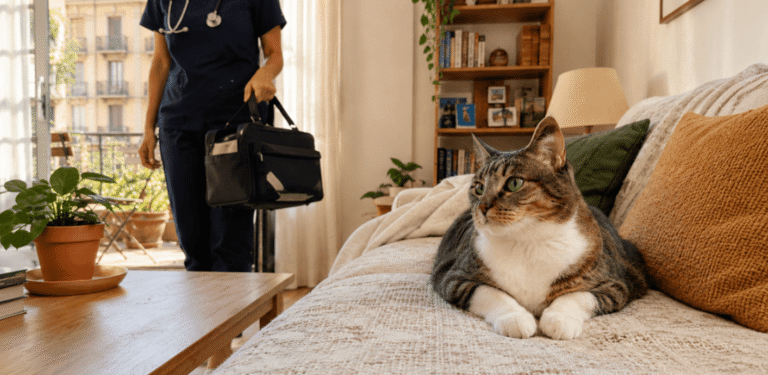
When a family looks for a home veterinary visit in Barcelona, they almost always have one very specific question: whether the same things can be done at home as in a veterinary clinic.
The honest answer is that many things can, but not everything. In a home veterinary visit you can carry out check-ups, vaccinations, microchipping, control tests, monitoring of chronic diseases and assessment of animals that become very stressed when leaving home. But there are procedures that require facilities, equipment or specific monitoring, such as X-rays, surgeries, hospitalization or emergency care.
At Animal Salut we have been carrying out home veterinary visits in Barcelona for more than 10 years. In fact, we were one of the first home veterinarians in Barcelona to commit to this type of care, when it was not yet such a common service. That experience has taught us something important: home visits can be a great help for many animals, but they should be used in the appropriate cases.
What is a home veterinary visit
A home veterinary visit is a consultation in which the veterinarian travels to your home to assess your pet in its usual environment.
It can be a very useful option for dogs, cats and other animals that get stressed by transport, elderly animals, families with multiple pets or people with mobility problems. Animal Salut already offers this service in Barcelona and the surrounding area, with home visits for procedures such as vaccinations, microchipping, laboratory tests and check-ups.
The big difference is that the animal does not have to go through the whole process of leaving the house. In many cases, the stress does not begin at the appointment, but earlier: when preparing the carrier, going outside, getting into the car, waiting at reception, encountering other animals, entering the room, paying and returning home.
There can also be stress at home, because the veterinarian is still a new person handling the animal. But that stress usually concentrates at the moment of the visit, without adding travel, a waiting room or the return home.
What can be done during a home veterinary visit
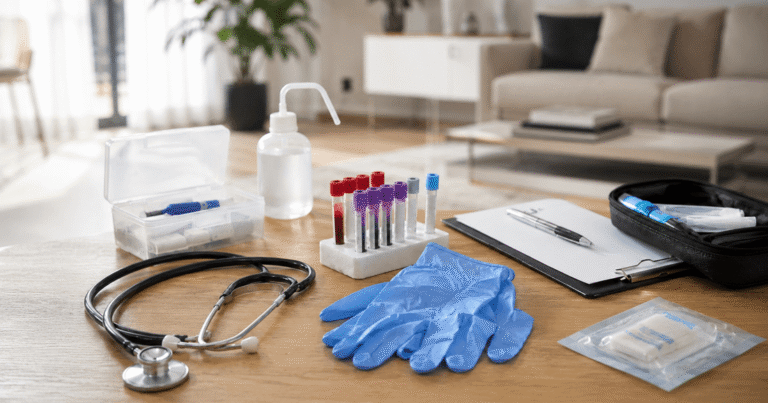
Many routine procedures can be carried out during a home veterinary visit, provided the animal’s condition allows it and specific facilities are not required.
The most common services include:
- General check-ups.
- Vaccinations.
- Deworming.
- Microchipping.
- Blood, urine or fecal tests, as appropriate.
- Geriatric checks.
- Monitoring of chronic diseases.
- Examination of the skin, ears, mouth, weight, mobility and general condition.
- Initial assessment of some minor problems.
- Guidance on feeding, medication and home care.
In our experience, many home veterinary visits are for vaccinations or control tests. These are cases in which, if the animal is stable and does not need complex tests, care at home can be comfortable and safe.
It can also be very useful for animals that are difficult to handle or that get very stressed when taken to the veterinarian. In these cases, a home visit helps reduce part of the stress associated with travel and allows assessment of the animal in a more familiar environment.
What cannot be done at home
Although the home-visit service is very useful, it does not completely replace a veterinary clinic. Procedures that require fixed equipment, clinical facilities, advanced anesthesia, or continuous monitoring cannot be performed at home.
For example:
- X-rays.
- Surgeries.
- Hospitalization.
- Tests that require specific machinery.
- Procedures with general anesthesia.
- Care for serious emergencies.
- Treatments that require oxygen, intensive monitoring, or hospital medications.
This does not mean that the home visit is less important. It means it has clear limits. If during the visit we determine that your pet needs a test or treatment that cannot be done at home, the responsible course is to advise you on the next safest step.
Animal Salut already states in its home service that when a test or treatment not available at home is needed, such as an X-ray or surgery, the case must be referred to the veterinary clinic or a referral center.
Are veterinary emergencies attended to at home?
In general, a home veterinary visit is not the appropriate option for an emergency.
The home service operates with scheduled appointments and planned travel. Therefore, although we try to help whenever possible, immediate, last-minute attention cannot be guaranteed.
In addition, many emergencies require tests, monitoring, oxygen, X-rays, surgery, or hospital medications that cannot be carried out safely at home. In these cases, attempting to resolve them at home can cost the animal vital time.
If your pet has difficulty breathing, seizures, severe pain, heavy bleeding, suspected poisoning, trauma, a swollen abdomen, inability to urinate, or rapid deterioration, the safest course is to go directly to a veterinary clinic or emergency service.
Home visits are a very useful option for scheduled visits, check-ups, vaccinations, lab tests, and follow-ups, but in a real emergency the priority should be to get to a facility equipped to act as soon as possible.
When to request a home-visit veterinarian
A home veterinary visit can be a good option when the animal is stable and the reason for consultation can be resolved without hospital resources.
Cats that get stressed by the carrier
Many cats suffer even before leaving the house. They hide, vocalize, pant, urinate on themselves, or arrive at the clinic so nervous that the examination becomes complicated.
In these cases, a home visit can greatly facilitate assessment. The cat may still become uncomfortable during handling, but much of the stress from transport and the waiting room is avoided.
Senior dogs or dogs with reduced mobility
Older dogs, those with osteoarthritis, weakness, or problems climbing stairs can suffer greatly with travel.
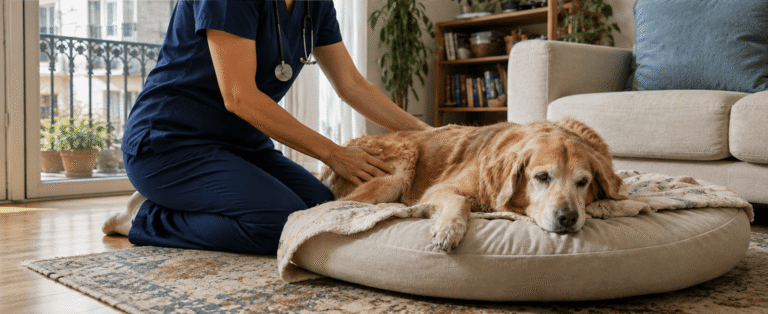
For them, a home check-up can be more comfortable, especially for geriatric check-ups, periodic blood tests, medication reviews, or quality-of-life assessments.
Animals that are difficult to handle
Some animals freeze up, defend themselves out of fear, or require especially careful handling. In these cases, a home visit can help reduce some of the stress, but each case must always be evaluated.
If an animal needs premedication or sedation, it must be prescribed by a veterinarian. You should never sedate a dog or cat on your own or reuse old medication without an up-to-date examination.
Households with multiple animals
When multiple animals live together, transporting them all to the clinic can be complicated. A home veterinary visit allows organizing check-ups, vaccinations, or tests for several animals in the same appointment, provided it is appropriate for each case.
Additionally, the veterinarian can observe the household environment, interactions, and some everyday factors that may influence health or behavior.
People with mobility issues
The home-visit veterinarian is also an important help for elderly people, families without a car, owners with mobility difficulties, or people who cannot easily travel.
In these cases, the home visit makes it easier for the animal to receive veterinary care without delaying necessary vaccinations, check-ups, or reviews.
When it’s better to go directly to the veterinary center
There are situations where it’s better not to request a home visit and to go directly to a veterinary center.
This happens when the pet needs diagnostic tests, urgent care, monitoring or treatments that cannot be performed safely at home.
Go directly to the center if you observe:
- Difficulty breathing.
- Seizures.
- Loss of consciousness.
- Severe bleeding.
- Severe pain.
- Trauma or being hit by a vehicle.
- Repeated vomiting with lethargy.
- Severe diarrhea with weakness.
- Suspected poisoning.
- Very swollen abdomen.
- Inability to urinate.
- Rapid deterioration of general condition.
In these cases, waiting for a home visit may delay necessary tests or treatments. And in an emergency, that time can be critical.
And what if during the visit a test is needed that cannot be done at home?
Sometimes a visit begins as a simple check-up and, during the examination, the veterinarian detects that more comprehensive tests are needed.
For example, if there is a suspected fracture, significant abdominal pain, difficulty breathing, a mass that requires evaluation, abnormal bloodwork or a problem that needs diagnostic imaging, it may be necessary to go to the center.
In that case, the home visit serves to make an initial assessment, guide the case and decide the next step. The important thing is not to force a home visit when the animal needs other resources.
At Animal Salut we can help you decide whether your case can be resolved at home or if it is better to go directly to the veterinary center.
Is a home veterinarian more expensive?
Price is one of the most frequent concerns.
A veterinary home visit may seem more expensive than a visit to a center, but it’s not exactly the same service. It doesn’t only include the veterinary examination, but also travel, preparation of materials, reserved time and more individualized care in the animal’s environment.
For many families it’s worthwhile because it avoids transportation, reduces stress, makes caring for several animals easier or allows a person with mobility problems to access veterinary services.
That said, when the animal needs X-rays, surgery, hospitalization or advanced tests, the most practical and safest option is usually to go directly to the center.
How to prepare for a veterinary home visit
Preparing the visit well helps make everything easier for the animal, the family and the veterinarian.
Before the appointment:
- Have the medical record, previous reports and current medication ready.
- Choose a quiet room with good light and little noise.
- Avoid the animal hiding in hard-to-reach areas.
- If it’s a cat, don’t chase it right before the visit.
- If it’s a nervous dog, avoid exciting it before the veterinarian arrives.
- Let us know if the animal bites, scratches, freezes up or defends itself out of fear.
- Do not medicate or sedate the animal without veterinary instruction.
The goal is not for the animal to “behave perfectly”, but to be able to work safely and with as much information as possible.
More than 10 years as a home veterinarian in Barcelona
Animal Salut was one of the first home veterinarians in Barcelona. We began making home veterinary visits when this type of service was still uncommon, and over all these years we have accompanied many families who needed more comfortable, close and personalized care adapted to their situation.
This experience allows us to know when a home visit can be very helpful and when it is better to recommend a visit to the center directly. Experience has also taught us that many owners are not only looking for convenience: they want to reduce their pet’s stress, avoid complicated travel or be able to care for several animals without moving them from home.
Over time, Animal Salut has grown and today combines that home experience with other veterinary services, always maintaining the same idea: adapting care to what each animal needs.
Home veterinarian in Barcelona with Animal Salut
At Animal Salut we offer home veterinary visits in Barcelona and surrounding areas for check-ups, vaccinations, blood tests, controls and follow-ups.
We can help you if:
- Your cat gets very stressed by the carrier.
- Your dog is elderly or has reduced mobility.
- You have several animals at home.
- You need vaccinations or routine blood tests.
- It’s difficult for you to get to the veterinary center.
- You don’t know if your case can be resolved at home or needs a center visit.
Before booking, we can advise you to choose the most appropriate option. The priority is always your pet’s safety and well-being.
Frequently asked questions about home veterinary visits
They can perform check-ups, vaccinations, microchipping, routine lab tests, deworming, follow-ups and a general assessment of the animal, provided that specific facilities or tests are not required.
No. Many routine visits can be done at home, but not X-rays, surgeries, hospitalization, serious emergencies, or tests that require specific equipment.
Yes. In many cases vaccines can be administered at home, always following a prior check of the animal’s general condition.
Yes. Many routine lab tests can be performed at home. Depending on the type of test and the animal’s condition, the veterinarian will indicate whether it can be done at home or if it is advisable to go to the clinic.
Yes, in many cases the microchip can be implanted during a home veterinary visit.
Only if indicated by a veterinarian. You should not sedate your pet on your own or use old medication without a current assessment.
It is not recommended. Emergencies require immediate attention and often tests or treatments that cannot be performed at home. Trying to handle an emergency at home can waste vital time for the animal.
If there is difficulty breathing, seizures, heavy bleeding, severe pain, poisoning, trauma, rapid worsening or any serious symptom, it is better to go directly to a veterinary clinic or emergency department.
Yes, it is usually a good option for cats that become very stressed by the carrier or travel. Still, each case should be assessed individually.
The price depends on the area, the type of visit and the services required. It is advisable to check the updated rate before booking to know what is included.
A home veterinary visit can be a great option for check-ups, vaccinations, laboratory tests and follow-ups, especially when travel causes stress or difficulty.
But it is also important to know its limits. At home you cannot perform X-rays, surgeries, hospitalization or treat serious emergencies with the same safety as in a veterinary center.
At Animal Salut we have been providing home veterinary visits in Barcelona for more than 10 years. We can help you assess whether your case can be resolved at home or if, for safety, it is better to go directly to the clinic.